
By the team at Brilliance AV — Arizona’s church AVL design and installation specialists
You can have the best speakers and the most skilled sound tech in the Phoenix Valley, and your church can still sound bad if the room itself is working against you. Acoustic treatment is one of the least discussed but most impactful factors in church sound quality — and many Arizona churches are operating in spaces that were never designed with audio in mind.
Why Room Acoustics Matter So Much
Sound doesn’t just travel from the speakers to your ears in a straight line. It bounces off walls, floors, ceilings, and hard surfaces — sometimes arriving at your ears milliseconds after the direct sound. These early reflections cause two problems: muddiness (when reflections blend with the direct sound and reduce clarity) and reverb buildup (when sound keeps bouncing long after it was produced, making speech unintelligible).
In a well-designed space with good acoustics, the sound tech is a polishing step. In a poorly designed space with bad acoustics, the sound tech is fighting the room every week — and losing.
Common Acoustic Challenges in Arizona Church Buildings
Phoenix Valley church buildings come in all shapes and sizes — from converted retail and warehouse spaces to traditional sanctuaries built decades ago. The most common acoustic problems we encounter:
Parallel walls: When two walls directly face each other (like in a rectangular room), sound bounces back and forth between them, creating flutter echo. You can often hear this as a metallic ringing or “ping” when you clap in an empty room.
Hard, reflective surfaces: Tile floors, drywall, glass, and concrete are all highly reflective. A room full of these materials is a nightmare for speech clarity. Churches in Arizona that meet in commercial or industrial spaces often face this challenge acutely.
High ceilings without treatment: Large volumes of air and high ceilings extend reverberation times. Beautiful for pipe organ music; less helpful for spoken word and modern worship bands with drums and electric guitar.
HVAC noise: Arizona’s climate demands significant air conditioning systems that run constantly. Poorly routed or sized HVAC ductwork creates a constant background noise floor that competes with speech and music.
Acoustic Treatment Options for Churches
The good news: acoustic problems are fixable. Here are the main treatment approaches:
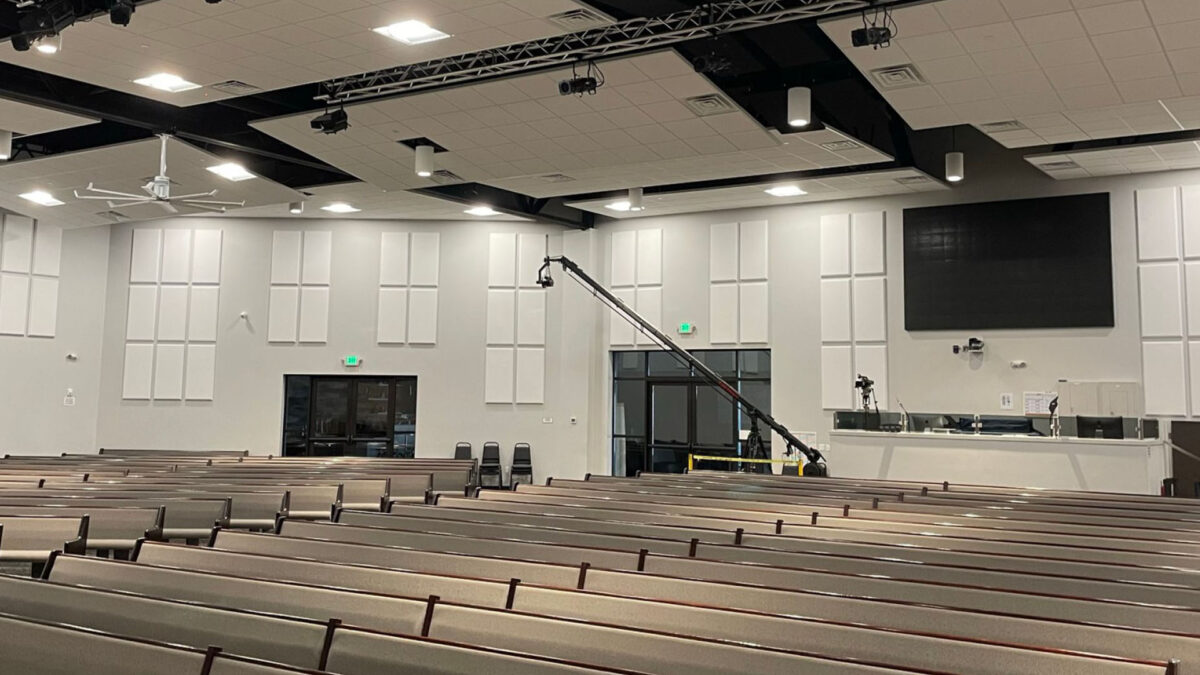
Acoustic panels: Fabric-wrapped panels filled with acoustic foam or fiberglass absorb mid and high frequencies and reduce reflections from walls. They can be mounted at “first reflection points” — the spots where sound from the speakers first bounces off side walls toward the congregation. Acoustic panels can be aesthetically integrated into a church’s design; they don’t have to look industrial.
Bass traps: Low frequencies (bass and sub-bass) are harder to absorb. Bass traps — thick panels or corner blocks filled with dense absorptive material — go in room corners where low-frequency energy builds up. Controlling bass buildup dramatically improves clarity for both speech and music.
Diffusion: Not all sound energy should be absorbed. Diffusers scatter sound in multiple directions rather than absorbing it, which adds life and spaciousness to a room without the dead feeling of over-absorption. The right balance of absorption and diffusion is key.
Carpet and soft furnishings: Carpet absorbs high frequencies significantly. In churches that have transitioned from carpet to hard floors for aesthetic reasons, reverb time has often increased noticeably. Adding rugs or upholstered seating can help.
How Much Acoustic Treatment Does Your Church Need?
The amount of treatment needed depends on the target reverberation time (RT60) for your room. Churches focused on spoken word and contemporary worship typically want a shorter RT60 (around 0.8–1.2 seconds). Traditional worship with a choir or classical music can tolerate longer reverb (1.5–2.0 seconds).
A professional acoustic assessment uses measurement tools to capture your room’s actual RT60 and frequency response, then recommends a treatment plan. Guessing without measurement often leads to over-treating some frequencies while under-treating others.
DSP: The Digital Complement to Physical Treatment
Physical acoustic treatment addresses the room itself. Digital Signal Processing (DSP) in your speaker system can correct for room response electronically. Modern DSP processors like the Dante-enabled units from QSC, BSS, and Biamp use Room EQ or FIR filtering to compensate for room problems.
DSP is not a replacement for physical treatment — it’s a complement to it. Trying to fix severe room acoustic problems purely through EQ leads to phase issues and artifacts. The best results come from treating the room first, then fine-tuning with DSP.
Brilliance AV: Acoustic Design for Arizona Churches
We incorporate acoustic considerations into every AVL project we design for Phoenix Valley churches. If your room is fighting your sound system, we can assess the situation and recommend a treatment plan that improves clarity, reduces reverb, and makes your sound tech’s job dramatically easier.
Contact us to discuss acoustic treatment for your Arizona church.