
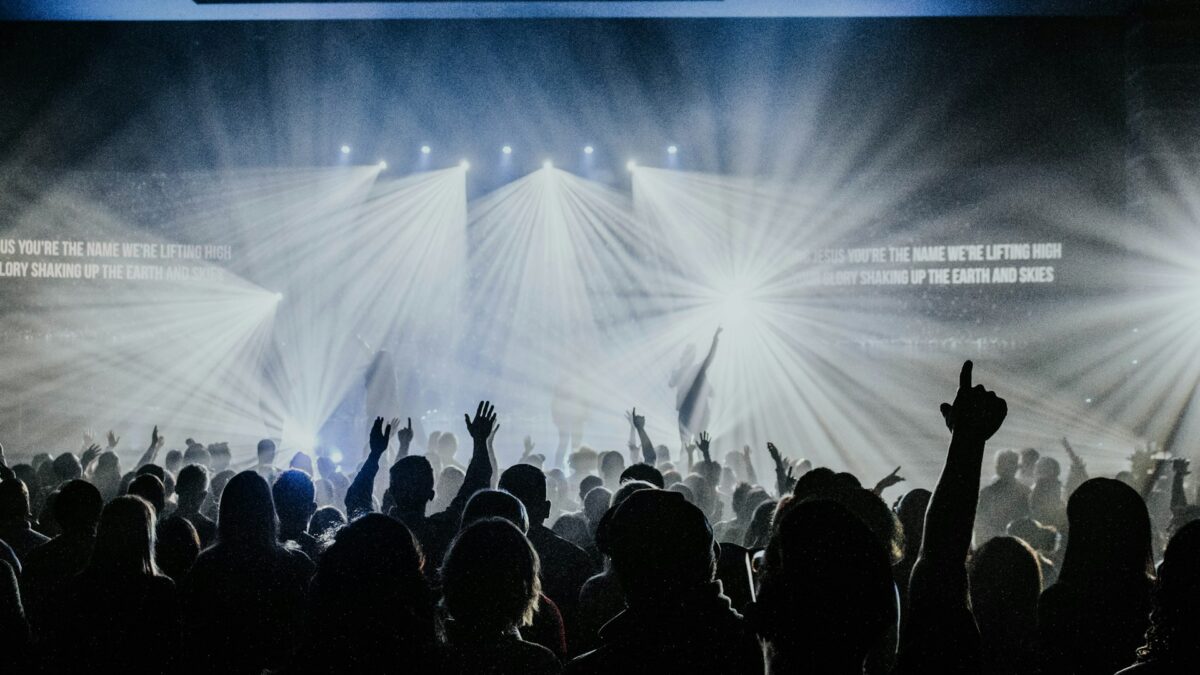
Every church has had the conversation. Someone says worship is too loud. Someone else says it needs more energy. The sound tech is caught in the middle, nudging faders based on whoever complained most recently. If that sounds familiar, take heart: “how loud should church be?” actually has an answer — and getting there is more about system design and consistency than about turning it down.
The Numbers, Plainly
Sound level is measured in decibels (dB), usually as an A-weighted average (dBA) over time. Here’s the practical range we see across Phoenix Valley churches:
A traditional service with speech and choir typically averages 75–85 dBA. A blended service usually sits around 85–92 dBA. Contemporary worship with a full band generally lands between 92 and 97 dBA on the loud songs, and high-energy youth or modern services may push 98–102 dBA in moments.
For reference, OSHA-style guidance allows hours of exposure at 90–95 dBA before hearing risk becomes a serious concern, and a 75-minute service spends only a fraction of its time at peak levels. In other words: most “too loud” complaints at 92 dBA aren’t really about hearing safety — they’re about harshness, inconsistency, or uneven coverage. Which is good news, because those are fixable.
Why the Same Volume Feels Different in Different Rooms
Here’s what most volume debates miss: perceived loudness isn’t just the number on the meter. A well-tuned system at 95 dBA can feel comfortable, while a harsh, poorly aimed system at 88 dBA feels punishing. Three factors matter enormously:
Frequency balance. Excess energy in the 2–4 kHz range — where the ear is most sensitive — reads as “painful” long before the meter reads high. This is the most common issue we find in untuned systems.
Coverage. If your speakers blast the front rows to reach the back, the people up front suffer while the back still complains it’s quiet. Uneven coverage guarantees that no single volume satisfies everyone. Many older sanctuaries in the Valley have speaker systems that simply were never designed for the room’s current layout.
Consistency. If volume jumps 6 dB depending on which volunteer is mixing, people experience the loud weeks as “the sound problem.” A defined target and a meter in the booth fix this fast.
Set a Standard, Not a Feeling
Our advice to every church: stop mixing to opinions and adopt a measured standard. Pick a target average (say, 93 dBA for contemporary worship, measured mid-room), display it on an SPL meter at front of house, and train every operator to it. Leadership signs off on the number once, and the weekly argument disappears. When someone raises a concern, you have data instead of a debate.
It’s also worth protecting the people for whom sound is a real issue: offer earplugs at the door (many Valley churches do), consider a designated quieter seating area away from the speakers, and make sure your nursery and cry-room feeds are at gentle levels.
When “Too Loud” Is Really a System Problem
If you’ve set a reasonable target and people still wince, believe them — but suspect the system, not the songs. Common culprits we find during evaluations: speakers aimed at walls instead of ears, no system processor (or one that’s never been tuned), subwoofers overpowering the room, and stage volume so high that the house mix is fighting the backline. Every one of those makes a service feel louder than it measures.
Room acoustics play a role too. Hard, reflective rooms — and Arizona has plenty of tile-and-drywall sanctuaries — smear sound into a wash that fatigues ears at any volume.
A one-hour system evaluation usually identifies which of these is doing the damage. In our experience, churches that “solved” a volume complaint by simply turning down often lost the energy of their worship without actually fixing the harshness — the worst of both worlds. Diagnose first, then decide.
Loud Enough to Move You, Clear Enough to Stay
The goal was never loudness for its own sake. It’s engagement: a congregation that can sing without feeling exposed, a message heard clearly in every seat, and a room where nobody is thinking about the sound system at all.
If your church is stuck in the volume wars, Brilliance AV can help. We measure, tune, and — where needed — redesign systems for churches across Tempe, Phoenix, and the entire Valley so that your services sound clear, comfortable, and consistent at any level. Contact us here and let’s end the debate for good.