
By the team at Brilliance AV — Arizona's church AVL design and installation specialists
We get this question from Arizona church leaders more than almost any other. Usually it goes something like this:
"We need to upgrade our sound system. But we also have terrible lighting on stage, our cameras look like they were borrowed from a middle school yearbook class, and we're pretty sure our wireless mics have been haunted since 2014. Do we need to hire five different companies for all of this? Or can one team handle everything?"
Great news: one team can absolutely handle all of it. That's literally what we do.
A professional church AVL integrator — AVL standing for Audio, Video, and Lighting — designs, supplies, installs, and supports every component of your church's technology environment as a single, unified system. Not a collection of mismatched gear from five different vendors with five different warranties and five different people to call when something goes wrong on a Saturday night.
So let's walk through exactly what a full-service church AVL installation includes — and why having one team handle all of it makes a meaningful difference for your congregation and your volunteer team every single week.
Why "Full-Service" Church AVL Matters
Before we get into the component breakdown, it's worth understanding why integrated installation matters so much in a church context specifically.
Every element of your AVL system talks to every other element. Your microphones feed your mixing console, which feeds your speakers and your livestream. Your lighting affects how your cameras see your stage. Your cameras connect to your video switcher, which feeds your displays and your streaming encoder. Your acoustic environment determines how your speakers need to be tuned.
When one company designs and installs all of it, those relationships are accounted for from the beginning. Everything is sized, configured, and calibrated to work together. When different vendors handle different pieces — or when a church buys gear from multiple sources and cobbles it together — those relationships become everyone's problem and nobody's responsibility.
We've been called in to untangle more than a few of those situations. The rescue is always more expensive than doing it right the first time would have been. (We say this with genuine compassion, not judgment. It happens to great churches with great leadership all the time.)
Here's everything that a comprehensive church AVL installation from Brilliance AV covers:
1. Microphones: Where Every Service Begins
Your pastor's voice is the single most important audio signal in your entire system. Everything downstream — the mixing console, the speakers, the livestream — is only as good as what the microphone captures in the first place. This is why microphone selection and placement deserves serious attention, not an afterthought purchase from a random online listing.
Wireless Handheld, Lavalier, and Headset Systems
For most Arizona churches, a wireless system is essential. Whether your pastor paces the stage, walks into the congregation, or does all of the above in a single sermon, a wireless mic gives them the freedom to communicate naturally without being tethered to a podium. We spec and install professional wireless systems — like the Shure SLX-D+ series — that provide clean, reliable signal across multiple simultaneous channels without interference. In the Phoenix metro's crowded RF environment, that reliability isn't optional.
Lavalier (clip-on) mics offer a discreet look for teaching pastors. Headset mics provide more consistent audio pickup for worship leaders who move a lot. Handhelds work well for open services, Q&A formats, and congregational microphones. We'll match the right configuration to how your team actually uses the stage.
Podium and Choir Microphones
Fixed microphones for the pulpit, lectern, or choir riser require their own consideration — pickup pattern, sensitivity, mounting style, and integration with your mixing console. We handle all of it as part of the complete mic system design.
Instrument Microphones for the Worship Band
If your worship team includes drums, guitars, keys, or other acoustic instruments, each one benefits from proper miking. Wired dynamics like the industry-standard Shure SM57 are workhorses for stage instrument pickup. Direct injection (DI) boxes handle keyboards and bass guitars. We design the complete stage input list as part of your system — not as an afterthought.
Feedback Prevention and RF Management
The number one fear of every church volunteer running audio is the dreaded feedback squeal — that ear-splitting shriek that happens when a mic gets too close to a speaker or the gain is turned up too high. Professional system design dramatically reduces feedback risk through proper speaker placement, microphone selection, and digital mixing consoles with built-in feedback management tools. We design the feedback out of the system rather than hoping your volunteers manage it manually every week.
2. Speaker Systems: Making Sure Every Seat Hears Equally Well
Here's a truth about church audio that surprises a lot of people: the goal isn't loud. The goal is even. Every seat in your sanctuary — front row, back row, side sections, overflow room — should hear the pastor's voice and the worship team at the same volume and with the same clarity. Achieving that requires thoughtful speaker system design, not just buying big boxes and pointing them at the congregation.
Main PA Speakers
The main speakers handle the primary sound coverage for your congregation. For smaller Arizona church sanctuaries, a pair of quality powered speakers like the QSC K.2 Series delivers professional coverage in a compact, clean-looking package. For larger rooms, we design line array systems, flown arrays, or distributed speaker systems that precisely cover the room's unique geometry. No dead zones. No "hot spots" where it's too loud. No back row that can't understand a word.
Subwoofers
For churches with contemporary worship — full band, electric bass, drums, keys — subwoofers add the physical dimension of low-end that makes worship feel complete rather than thin. For primarily acoustic or spoken-word environments, a sub may not be necessary. We make that determination based on your actual worship style, not a generic spec sheet.
Stage Monitors and In-Ear Monitors
Your musicians need to hear themselves clearly on stage to perform confidently and stay in pitch. Traditional floor wedge monitors work for many situations. In-ear monitor (IEM) systems — where musicians receive a personalized mix directly in their ears — are increasingly the professional standard in Arizona churches because they dramatically clean up stage volume, reduce feedback risk, and let musicians hear a custom mix of exactly what they need. When your worship team can hear themselves clearly, your front-of-house mix gets cleaner almost automatically. It's one of those upgrades that transforms multiple problems at once.
Delay Speakers and Distributed Audio
For churches with long rooms, balconies, cry rooms, lobbies, or overflow spaces, distributed speaker systems ensure audio reaches every corner of your facility clearly. Delay speakers at the back of a long sanctuary prevent the "echo" effect that happens when sound from the main speakers arrives later than the rear-fill speakers. We account for all of this in the system design — not just the main room.
Digital Signal Processing (DSP) and System Tuning
This is the step most DIY church audio installations skip — and it's one of the most impactful things we do. After installation, we use professional acoustic measurement tools to tune your speaker system to your specific room. We correct for room resonances, adjust time alignment between speaker zones, and optimize the frequency response so your system sounds its best in your actual space. The difference between a tuned system and an untuned one, even with identical equipment, is dramatic and immediate.
3. The Digital Mixing Console: The Brain of Your Audio System
Every microphone and audio input in your sanctuary flows into the mixing console. The console is where your volunteer sound tech shapes and balances what the congregation hears — and what goes to your livestream, your record output, and your stage monitors.
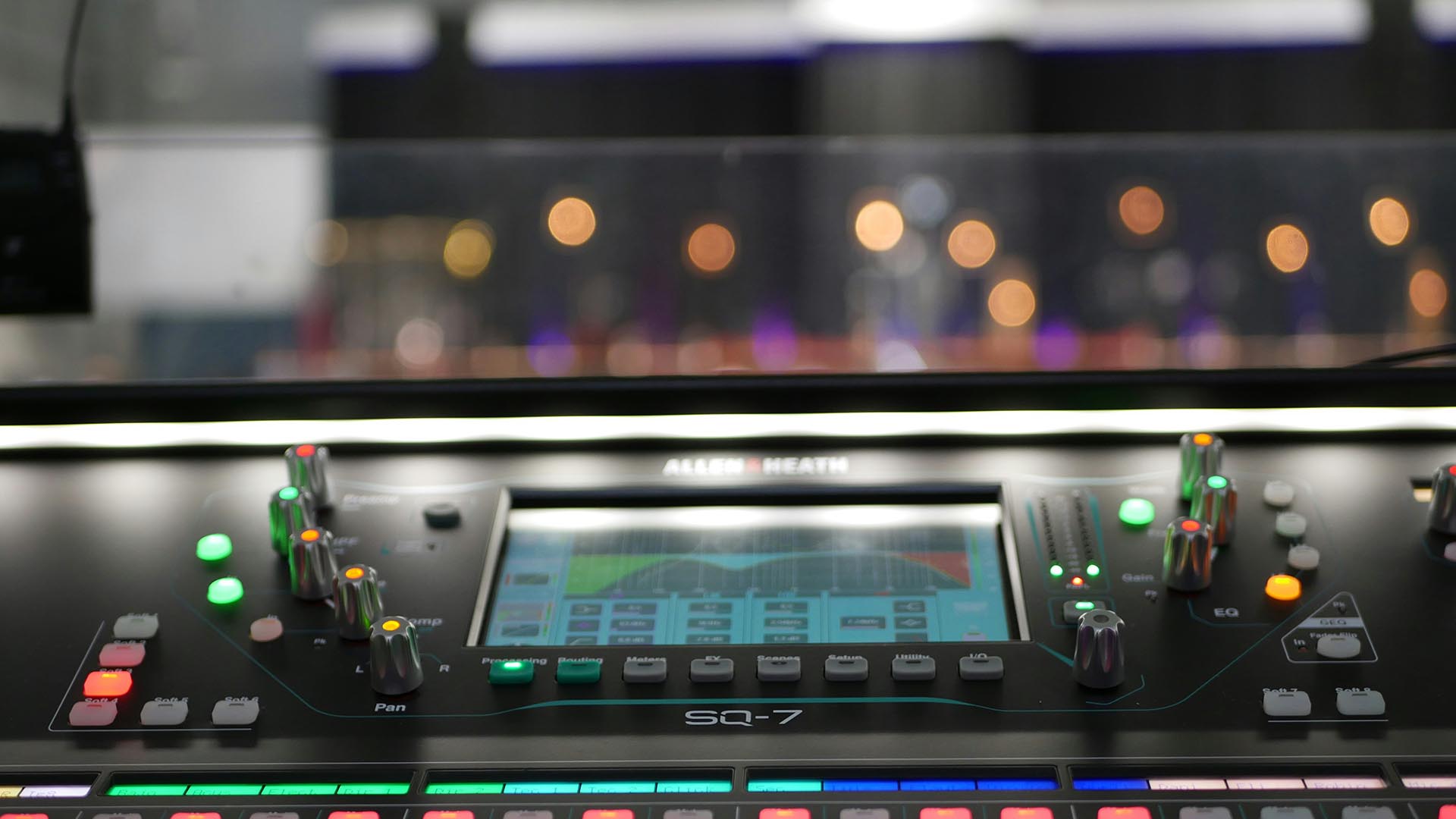
Modern digital mixing consoles have transformed what's possible for volunteer-operated church audio. Platforms like the Allen & Heath CQ Series include built-in feedback detection, automatic gain management, scene recall (where your volunteer can recall a complete service setup with one button press), and Wi-Fi control from a tablet so your sound tech can walk the room and hear what the congregation actually hears while adjusting the mix.
We select the right console for your church's channel count, worship style, and volunteer skill level — then program it with the presets, labels, and simplified layouts that make it genuinely usable for non-engineers. Because your sound tech deserves to actually enjoy Sunday mornings.
4. Video Displays: Screens, LED Walls, and Confidence Monitors
The visual side of your sanctuary — where congregation members see lyrics, scripture, sermon notes, and video content — is as important as the audio side. A well-designed video system removes visual barriers so your congregation can stay fully engaged without squinting, craning their necks, or wondering why the screen cuts off the last word of every verse.
LED Walls
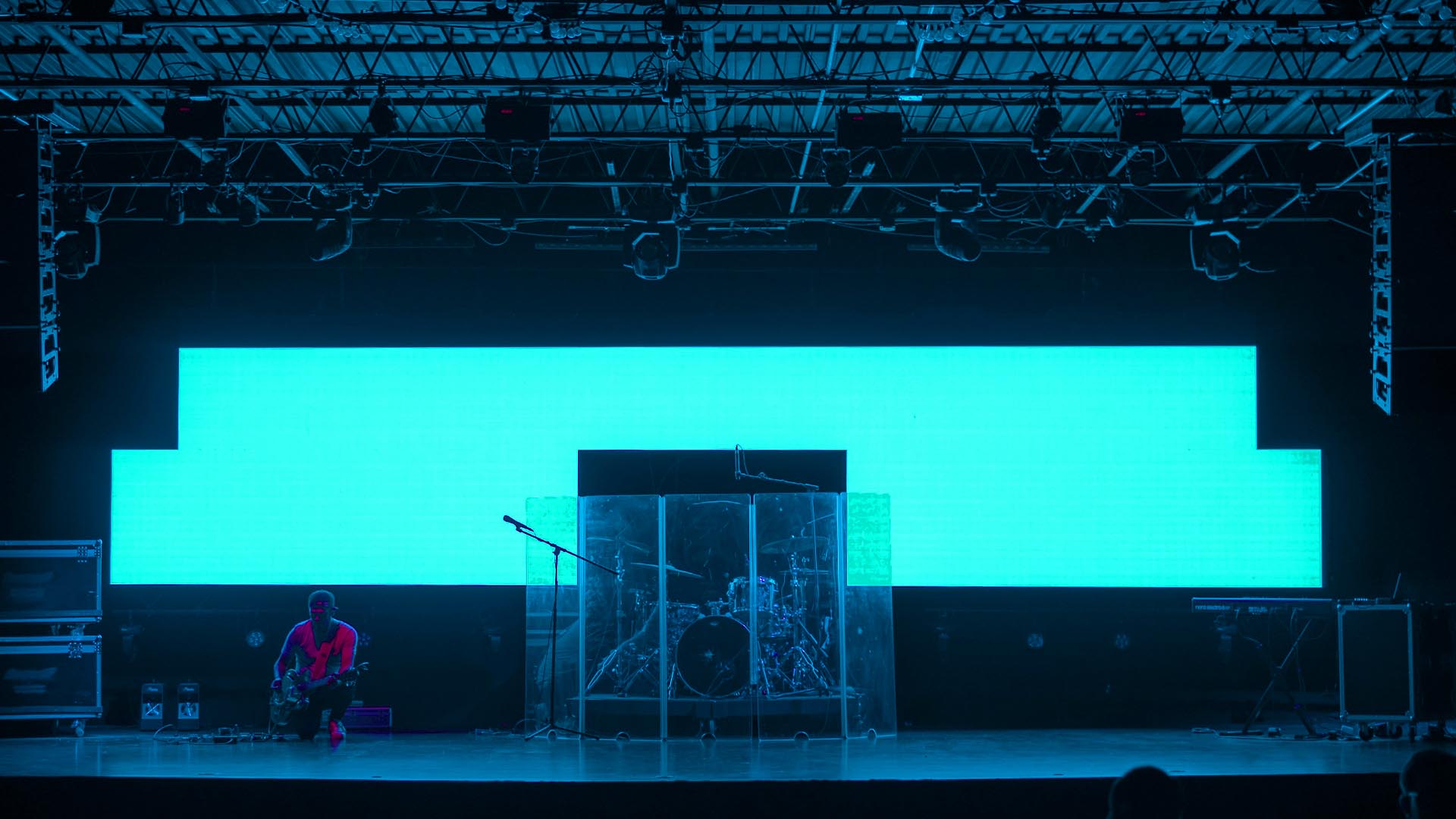
LED walls are rapidly becoming the standard for Arizona churches with contemporary worship environments. They're dramatically brighter than projection — a significant advantage in the bright, high-ambient-light environments common in Phoenix-area facilities — and they provide stunning image quality for worship backgrounds, sermon graphics, and video content. We design, supply, and install LED wall systems sized and specified for your specific room and viewing distances. Read more about LED walls for Arizona churches in our dedicated guide.
Projection Systems
For churches where projection still makes sense — budget constraints, room geometry, preference for a traditional aesthetic — we design and install professional projection systems with the brightness, contrast, and placement geometry needed to produce a clear, readable image in your space. This is not a "hang a projector from the ceiling and aim it at the wall" situation. Proper throw distance, lens selection, screen gain, and surface flatness all matter.
Confidence Monitors and Stage Displays
Your pastor and worship leaders need to see what's on the main screens without turning their backs to the congregation. Floor monitors or discreetly placed stage displays show the current slide content so everyone on stage stays coordinated with what the congregation is seeing.
Video Switching and Signal Distribution
Behind every display is a video signal chain that routes content from your media servers, ProPresenter workstation, camera feeds, and external sources to the right screens at the right time. Professional video switching ensures clean, reliable transitions between sources — no flickering, no black screens, no "why is the wrong thing showing" moments during the sermon.
5. PTZ Cameras: Reaching the People Who Can't Be There in Person
If you're not livestreaming your services in 2026, you're leaving a significant portion of your ministry reach on the table. Homebound members, traveling families, people who attended once and want to stay connected — your online audience is real and it matters. And the quality of your video production is the first thing they judge when they tune in.
PTZ cameras — Pan, Tilt, Zoom — have become the professional standard for church livestreaming because they deliver broadcast-quality video while being operable by a single volunteer from the back of the room. No camera operators walking the aisles. No extra people needed on the production team. One person with a controller can run a professional multi-camera show.
What a Professional PTZ Camera System Includes
- Multiple camera positions — typically a wide "room" shot, a center close-up on the pastor or worship leader, and a side angle for variety
- 4K resolution — most professional PTZ cameras for church applications now capture in 4K, ensuring a sharp, professional image even when streamed at 1080p
- Optical zoom — quality PTZ cameras offer 12x to 30x optical zoom, enabling tight close-ups on the pastor's face from the back of even a large sanctuary
- Low-light performance — church sanctuaries often have dramatic lighting changes during worship. Professional camera sensors handle these transitions without the grainy, washed-out look of consumer cameras
- Hardware controller — a dedicated joystick and recall controller allows your volunteer to move cameras, recall preset positions, and switch angles smoothly and confidently
Brands like Sony, PTZOptics, and Canon produce professional church-grade PTZ systems that we regularly integrate into Arizona church installations. The right choice depends on your room size, lighting conditions, budget, and streaming workflow.
Streaming Encoders and Platform Integration
Getting the camera signal from your sanctuary to YouTube, Facebook Live, your church app, or your website requires a streaming encoder — a device that packages your video and audio into the format streaming platforms require. We configure the complete streaming chain so your volunteer can start a stream with a single button press rather than troubleshooting settings five minutes before service starts.
6. Stage and House Lighting: Setting the Stage for Worship
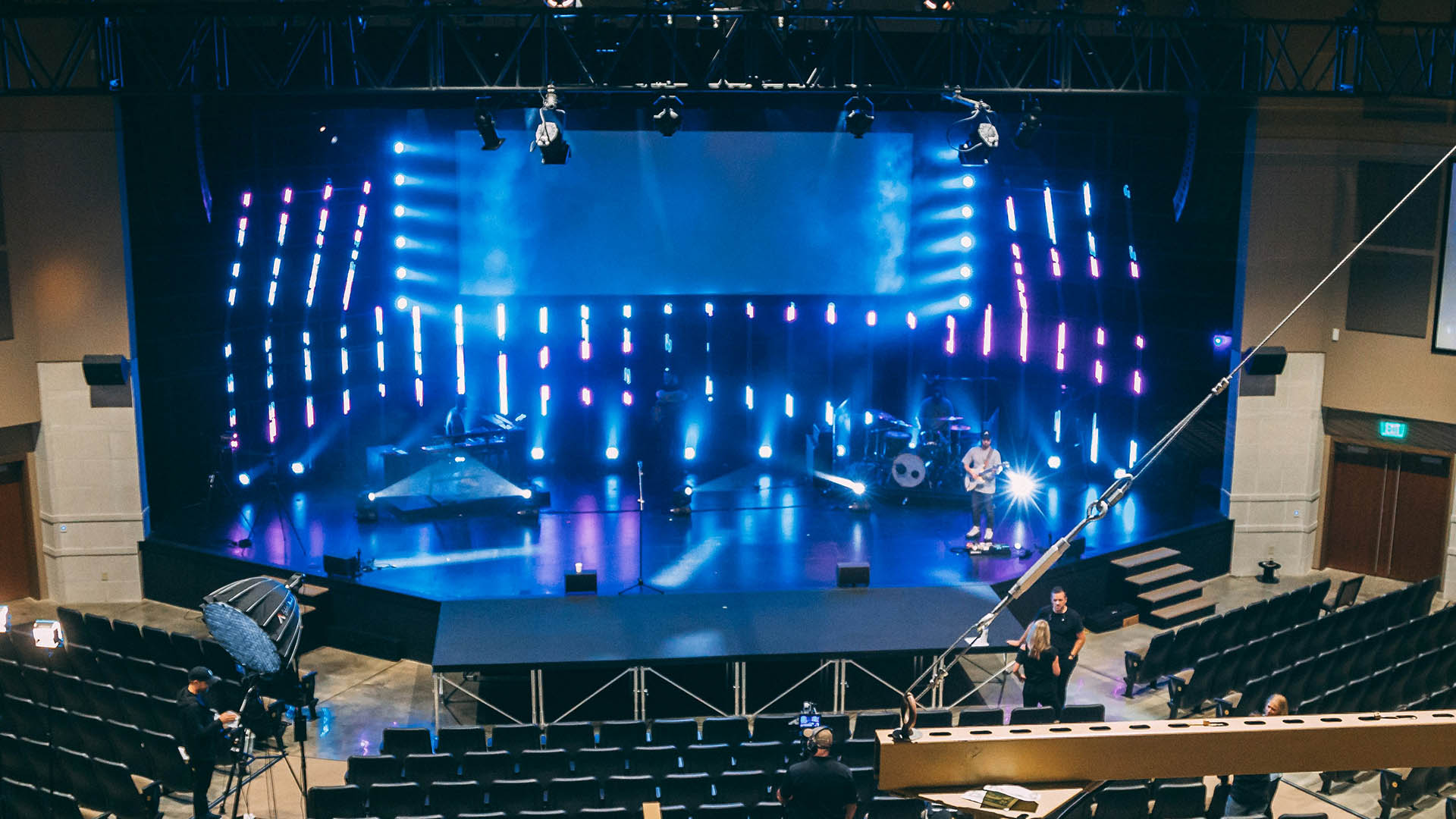
Lighting may be the most underappreciated element of the worship environment. Churches that invest in quality lighting consistently report that it transforms the feel of their services — not in a "rock concert" way, but in the way that a beautifully lit space communicates intentionality, professionalism, and care. Your congregation notices, even when they can't articulate exactly why.
And from a purely practical standpoint: if you're livestreaming, your lighting is what makes your cameras work. Without adequate, well-placed stage lighting, even an expensive camera produces flat, dim, unflattering footage. Good lighting makes everything — the in-person experience and the online experience — dramatically better.
Stage Lighting
Stage lighting serves several distinct purposes, and a well-designed system addresses all of them:
- Front wash lighting — ensures your pastor and worship leaders are clearly illuminated from the front with natural-looking light. This is the single most important lighting improvement most Arizona churches can make. Proper front lighting means your pastor doesn't look like a silhouette against a bright background, which is what happens when stage lighting is absent or poorly designed.
- Color wash lighting — LED wash fixtures can paint your stage and backdrop with color, creating an atmosphere that shifts with the tone of the service. Warm ambers for intimate moments. Cool blues for reflective worship. Energetic mixed colors for high-energy praise. All controllable by your volunteer from a simple lighting board or tablet.
- Backlight and separation lighting — lighting from behind and above the stage creates visual depth and separation between your worship leaders and the background, making the on-stage environment look dimensional and professional on camera rather than flat and two-dimensional.
- Baptistery lighting — if your sanctuary includes a baptistery, proper lighting ensures this significant ministry moment is clearly visible to everyone in the room and looks beautiful on video.
House Lighting
The congregation needs light too — enough to read their Bibles, take notes, see the people around them, and navigate safely. House lighting systems for churches need to integrate with stage lighting so both zones can be controlled together, with simple presets for different service moments (welcome, worship, sermon, response, closing).
Modern LED house lighting systems are also dramatically more energy-efficient than the incandescent or fluorescent fixtures most Arizona churches are still running. LED fixtures use up to 75% less energy than traditional sources and last tens of thousands of hours — reducing both your utility bill and the number of times someone has to climb a very tall ladder to change a bulb in your 30-foot ceiling.
Lighting Control Systems
All of this lighting — stage, house, specialty zones — is brought together through a centralized lighting control system. Simple DMX console programming allows your volunteer to recall complete lighting scenes with a single button press: one button for the pre-service look, one for worship, one for the sermon, one for closing. No lighting degree required. No tweaking individual fixtures mid-service. Just confident, consistent control that makes your volunteer feel like a professional every Sunday.
7. Acoustic Treatment: When the Room Itself Is the Problem
Sometimes the biggest obstacle to great church audio isn't the equipment — it's the room. Many Arizona churches occupy spaces that weren't originally designed for amplified worship: converted retail spaces, multipurpose fellowship halls, traditional sanctuaries with tile floors and hard reflective surfaces, or newer buildings with parallel walls and low ceilings that create standing waves and comb filtering.
When a room has too much echo or reverberation, speech intelligibility suffers even with a great sound system. Choir and band music becomes muddy. The sermon sounds like it's being delivered inside a racquetball court.
Acoustic treatment — strategically placed absorptive panels, diffusers, bass traps, and sometimes ceiling clouds — tames the room and lets your sound system do its job. We assess the acoustics of every room we work in and recommend treatment solutions that address the actual problems in your specific space. Acoustic treatment is often far less expensive than people expect, and the improvement it delivers is almost always immediate and dramatic.
8. Infrastructure: The Foundation Everything Runs On
Here's the part of the installation that's invisible but absolutely critical: the cable runs, conduit, rack systems, power distribution, and network infrastructure that everything runs through.
Professional installation means:
- Properly rated and routed cabling — not extension cords zip-tied to the ceiling or audio cables running next to power lines (which causes interference)
- Dedicated electrical circuits — audio and video equipment needs clean, isolated power. Sharing circuits with HVAC systems, lighting dimmers, or other electrical loads causes noise and interference problems that are maddening to diagnose after the fact
- Network infrastructure — modern AVL systems are increasingly networked. Digital audio over Ethernet (Dante), IP-controlled cameras, cloud-managed mixing consoles, and streaming systems all require a properly designed and configured network to function reliably
- Equipment racks — properly ventilated, organized, and labeled equipment racks keep your gear accessible, serviceable, and running cool — important in any environment, critical in Arizona summers
- Future-ready conduit — we run conduit and pull spare cable during installation so that when your church grows and needs to add capabilities, we're not cutting open walls to add new runs
This infrastructure work is unglamorous. Nobody gets excited about conduit. But it's what separates a system that works reliably for a decade from one that develops mysterious gremlins every few months.
9. Training Your Volunteer Team
A system is only as good as the people operating it. And in the world of church technology, those people are almost always dedicated volunteers who have full-time lives outside of Sunday morning.
Part of every Brilliance AV installation is thorough volunteer training — not a thirty-minute overview on installation day where someone smiles, hands over a manual, and drives away. Real training, designed around how your specific volunteers will use your specific system in your specific services.
We walk through every operational scenario: setting up for a regular Sunday service, adjusting for a special event, handling the most common issues that come up during a service, and knowing what to do when something unexpected happens. We make sure your team finishes training feeling confident, not overwhelmed.
And we're available after installation too. Our ongoing service and support means your team has someone to call when questions arise — whether that's a week after installation or a year later when you add a new worship leader with different monitoring preferences.
Do You Have to Replace Everything at Once?
Not necessarily — but this requires an honest conversation. If you have existing gear that's still performing well, a good integrator will evaluate what's worth keeping and what should be replaced. Sometimes your speakers are fine but your console is outdated. Sometimes your lighting rig just needs LED retrofits rather than a full replacement. Sometimes everything is so far past its useful life that starting fresh is genuinely the more economical path.
What we always recommend: even if you're phasing your project over time, plan the complete system first. Know where you're going before you take the first step, so every dollar you spend today moves you toward the complete vision rather than creating incompatibilities you'll have to resolve later. We wrote a whole blog on exactly this topic — why buying church AV piece by piece almost always costs more — and it's worth a read before you make any purchasing decisions.
Frequently Asked Questions: Church AVL Installation in Arizona
Does Brilliance AV handle audio, video, AND lighting — or just one of those?
All three, fully integrated. Audio, video, and lighting are designed together as a unified system because they affect each other in significant ways. Your lighting affects how your cameras perform. Your speaker placement affects your acoustic treatment needs. Your video switcher connects to your streaming encoder. When one team designs and installs all of it, those connections are accounted for from the beginning. That's our complete approach.
How long does a full church AVL installation take?
It depends significantly on the scope of the project. A smaller system for a church of 50–100 people might be installed and operational in a week. A comprehensive installation for a 300-seat sanctuary with full audio, LED wall, multi-camera livestreaming, and a complete lighting rig typically takes two to four weeks of on-site work. We work around your ministry schedule — mid-week services, choir rehearsals, and special events — so the installation doesn't disrupt your church's life.
Can we keep our existing sound board or speakers?
Maybe. We'll evaluate what you have as part of the design process and give you an honest assessment of what's worth integrating and what should be replaced. We have no interest in replacing functional gear just to sell you more equipment. We do have a strong interest in building you a system that actually works as a cohesive whole — so if existing gear creates compatibility problems or performance gaps, we'll tell you that clearly and explain why.
What if our church is in a temporary or rented space?
Temporary and portable environments have their own design considerations — packable gear, quick setup, portable rigging — but the same professional design principles apply. We've built systems for Arizona church plants in school gyms, movie theaters, strip mall spaces, and community centers. The goal is always the same: a system that works great, sets up efficiently, and makes your volunteers' lives easier every week.
Do you work with churches of all sizes and budgets?
Yes. We work with church plants running their first real system and with established congregations doing complete facility renovations. The design process scales to your situation. We'll work within your real budget and build a system that serves your ministry faithfully at whatever scale makes sense right now — with an eye toward where you're going, not just where you are today. Start a conversation with us and let's figure out what that looks like together.
The Bottom Line: One Team, One System, Zero Headaches
The answer to the question at the top of this blog is a clear, unambiguous yes: a professional church AVL integrator handles microphones, speakers, cameras, lighting, displays, acoustic treatment, infrastructure, and everything in between — designed as a unified system, installed by one team, supported by one point of contact.
For Arizona churches ready to stop managing a collection of mismatched gear and start serving their congregations with technology that actually works every week, that's what we offer at Brilliance AV.
We design it. We build it. We tune it. We train your team on it. And we stick around to support it long after installation day — because your ministry doesn't pause, and neither should your technology.
Focus the many on the One. That's what great AVL design does. And we'd love to help your Arizona church experience it.
Ready to talk about what a full AVL system could look like for your church? Contact the Brilliance AV team for a no-pressure conversation about your space, your ministry, and your vision. No jargon. No overselling. Just honest expertise from a team that genuinely cares about getting it right.
Let's build irresistible experiences.
Connect With Us
Planning a project? Share your vision with us through this form, and we'll connect with you shortly.
Church Plant AVL Guide: Everything Church Plants Need to Know About Audio, Video & Lighting

LED Walls for Churches in Arizona: What to Know Before You Buy
Why Buying Church AV Equipment Piece by Piece Costs Your Arizona Church More in the Long Run
Best Audio Equipment for Small Church Sanctuaries: Budget-Friendly Solutions That Actually Work
What’s the Right Church Sound System for My Congregation Size? Matching Equipment to Needs
Choosing the Best Display Technology for Your Arizona Church Worship Center
Lighting Design for Worship Services: Creating the Right Atmosphere in Arizona Churches